As the years continue to come and go I find myself often reliving certain memories.
Why do specific recollections stand out so profoundly?
Could be a variety of reasons for this, might be because of who accompanied you on your adventure, maybe the location where it took place, possibly the weather conditions during the event, and so on.
For me, a certain fishing technique triggers some of my most recalled reminiscences. The method responsible for these wonderful memories is; “Down Rigging”. Although not having an extensive down rigging history, reliving these excursions definitely stand out.
The reason for not having a great deal of experience with this exhilarating approach is my proximity to typical “deep water” species. The area where I live doesn’t offer abundant Lake Trout opportunities and the nearest Salmon fishing is beyond what I’m willing to travel. There are some Lake Trout waters available but as my outings are decreasing with every passing year when I do get to get out to wet a line it usually has to be close by and easily accessible.
I could use this technique for walleye but my walleye fishing is mostly concentrated on the Ottawa River where I find it very difficult due to a very inconsistent bottom which is where I like to concentrate my efforts.
It is a good idea to maintain a buffer zone between your cannonball and the bottom so as not to get hung up if you troll over a hump or an abrupt escalation of the bottom, not to mention the debris-filled structure lying beneath you on this historical waterway.
Common characteristics of this historic river are the ever-fluctuating depths combined with an unforgiving and snag-filled bottom. These peculiarities enabled me to master another of my favorite techniques to produce fish, “Bottom Bouncing”! This approach also provides me with many enjoyable and productive getaways.
A good definition for downrigging that portrays the approach best is, “controlled depth” fishing. A quick explanation of this terminology is, having the ability to position your presentation at the depth of your choice. Seeking suspended fish, those that are marking a substantial distance off the bottom on your fish finder is usually a good starting point. This however doesn’t mean that you can’t entice fish near the bottom to make an abrupt ascent to attack your bait. In researching this deep water method of fishing further I uncovered data stating that “Lake Trout” are known to emerge 30 feet and beyond to chase prey.
It is a good idea though to maintain a buffer zone between your cannonball and the bottom so as not to get hung up if you troll over a hump or an abrupt rise in the bottom.
Downrigging probably associates most with big water fishing like that found on the great lakes or big deep inland lakes. Although this is not necessarily always the case, searching the depths for cold-water species like Salmon and Lake Trout which are usually much more plentiful on the great lakes does account for a large percentage of the downrigging fraternity.
Now, while the above statement is probably pretty accurate this post’s objective is to re-live one of my favorite fishing memories as well as possibly light a fire under some of you to try this adrenaline-charged rush!
Many years ago a group of us got together for a fishing trip into Algonquin Park. The location we chose had drive-to access as well as being boat launch facilitated.
This was an important factor because it was the middle of the summer and we were in search of deep-water lake trout.
Although this feat was possible to accomplish with a canoe it was much more practical by boat. With the group all being equipped with deep-water”trolling rods and reels” and a good supply of large trout enticing lures I also included my clamp-on downrigger, medium action rod and reel, light tackle, and my portable fish finder.
Probably not as popular as this method is out on the great lakes or on large inland lakes where you can add salmon to the mix, backcountry lake trout fishing is also conceivable with a small or portable downrigger.
Now, although this is possible on its own the experience is much more enticing and practical if you can also add a portable fishfinder. In my opinion, being aware of the depth your in is crucial, if for nothing else, to give you the knowledge as to what depth you should run your cannonball.
A second big advantage of a fish finder is to locate any suspended fish.
A great example of this brings me back to that trip into Algonquin Park. I remember it like it was yesterday.
Our group had 3 boats in all and everyone but myself was working their heavy “trolling” rods on or near the bottom with very little success.
I was keeping in constant communication with my buddy who was operating the motor and monitoring the fish finder for depth readings as well as replying to my continual inquiries regarding if we were marking any suspended fish?
It wasn’t long before he informed me that we were in 80 feet of water and that we had started marking fish at 60 feet.
Immediately I reset my downrigger to 55′ allowing for my presentation to drop slightly behind my cannonball.
In a matter of minutes, my rod tip started to twitch, which was then followed by the invigorating spectacle of my rod springing from its exceedingly bowed position a new-sprung and erect stance. Fish-on!
I quickly grabbed my rod from the rod holder and began to retrieve the slack in my line which was created on the release from the cannonball. As the excess line began to tighten up on my reel I thrust my rod forward and set the hook, the battle was on!
Fighting this fish on a regular spinning rod with light line at 60′ down is an experience all on it’s own, a feeling that, for me, cannot be over-exaggerated. The struggle that ensued probably lasted at least 15 minutes and turned out to be a very respectable 4 to 5-pound lake trout. Still excited, the sight of this lake trout left me dumbfounded though, if this fish would have gotten off without seeing it I would have definitely presumed it to be a 20 pounder or larger. Fighting this fish from that far down on light tackle gives you an undeniable sense of a much heavier fish, a fish that is in a life and death struggle to return to the safety of the depths below.
This story didn’t end there, this encounter was only the first of many that weekend. Some of the other guys managed to land a few with their customary trolling rods but my portable downrigger was definitely the hit of the party.
This is not my only downrigging recollection but it is my favorite. I’m sure it will continue to bring me pleasant memories of a weekend that will never be forgotten!
Isn’t that what it’s all about!
It may not be your cup of tea but if you get a chance get out and downrigging a try!




 One of the things that I often speak of when I’m out on the Ottawa is the role the current plays in having a successful outing. To corroborate this principle, I very rarely go out on a Sunday evening because I have noticed that this element, which I believe to be key in achieving success is very often lacking or not present at all. The element I’m referring to is the water flow which is created when the Otto Holden Dam, located just north of Mattawa is releasing water from the reservoir above. The amount that passes through at any given time also influences the role the current plays in this equation. The more water discharged at one time the greater the flow of the water below.

 As I stated in Part 1 of this post the only success I’ve experienced in August was by trolling but the perplexing part of that was that I was only in nine feet of water where I found some congregated. This was not a singular occasion; I yielded a few walleyes in this location on different occasions.


 a whole lot this summer. Although loving this approach I would much rather wait until we both can get out and share some father/son time. Our go-to strategy when we’re out together is simply bouncing a jig tipped with a minnow off the bottom which is usually very productive, especially early in the season.


 boat but still doable with how high it sits on the water, but I knew this going in with my previous ownership of one of these boats. It does need a few modifications which are currently underway but I should be able to be on the water this weekend!
 Before I start and get into my first topic I would like to say Thank-You to those of you who continued to visit my blog as well as my Facebook page during my absence. Your support, by continuing to visit helped me to realize just how much I enjoy banging away on my keyboard and reliving some of the happiest memories of my life.
 For me, a certain fishing technique triggers some of my most recalled reminiscences. The method responsible for these wonderful memories is; “Down Rigging”. Although not having an extensive down rigging history, reliving these excursions definitely stand out.


 Preparing my delicacy varies somewhat at times because I like to try different methods and recipes but the bottom line is I love eating fish! (think I already said that, lol)
 and wait for the slack in your line to tighten up then set the hook!
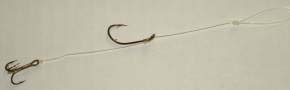
 a juicy nightcrawler looks much more natural if it’s outstretched rather than all coiled up.